What Are the Major Decisions of the 57th GST Council Meeting?
The 57th GST Council Meeting, held on 8 October 2026 in New Delhi under the chairpersonship of Union Finance Minister Nirmala Sitharaman, introduced several recommendations aimed at simplifying India's Goods and Services Tax (GST) framework. Unlike reforms focused primarily on tax rates, this meeting concentrated on ease of doing business, faster GST refunds, reduced litigation, wider Input Tax Credit (ITC) eligibility and simpler compliance procedures.
These changes could benefit small businesses, manufacturers, exporters, e-commerce sellers, startups and tax professionals by reducing administrative burdens and improving working capital management. According to the official government announcement, the Council recommended reforms covering registration, return filing, refunds, dispute resolution, prosecution and movement of goods across states. The recommendations will require the relevant notifications, amendments or implementation guidelines wherever applicable.
Key Numbers at a Glance
| Measure | Current / earlier figure | Proposed figure | Potential implication |
|---|---|---|---|
| Provisional refund | — | 90% of eligible claim | May release eligible working capital earlier. |
| Refund acknowledgement / deficiency memo | 15 days | 10 days | Shorter initial processing timeline. |
| General penalty under Section 125 | ₹25,000 | ₹10,000 | Lower proposed maximum for the specified general penalty. |
| Prosecution threshold | ₹1 crore | ₹5 crore | Higher proposed monetary threshold for prosecution. |
| Minimum threshold for GST show-cause notices | — | ₹10,000 combined tax amount | Could reduce low-value disputes, subject to the final provision. |
| Input-service ITC refund under inverted duty structure | — | Credit availed on/after 1 November 2026 | Potential relief from accumulated eligible ITC. |
| Capital-goods ITC refund | — | 60-month spread; qualifying credit from 1 April 2027 | Proposed mechanism for eligible credit relating to zero-rated supplies and inverted duty structure. |
| ARQP concept | — | Turnover up to ₹5 crore; B2C-only supplies as described | Approved in principle; operational details still required. |
Visual Summary
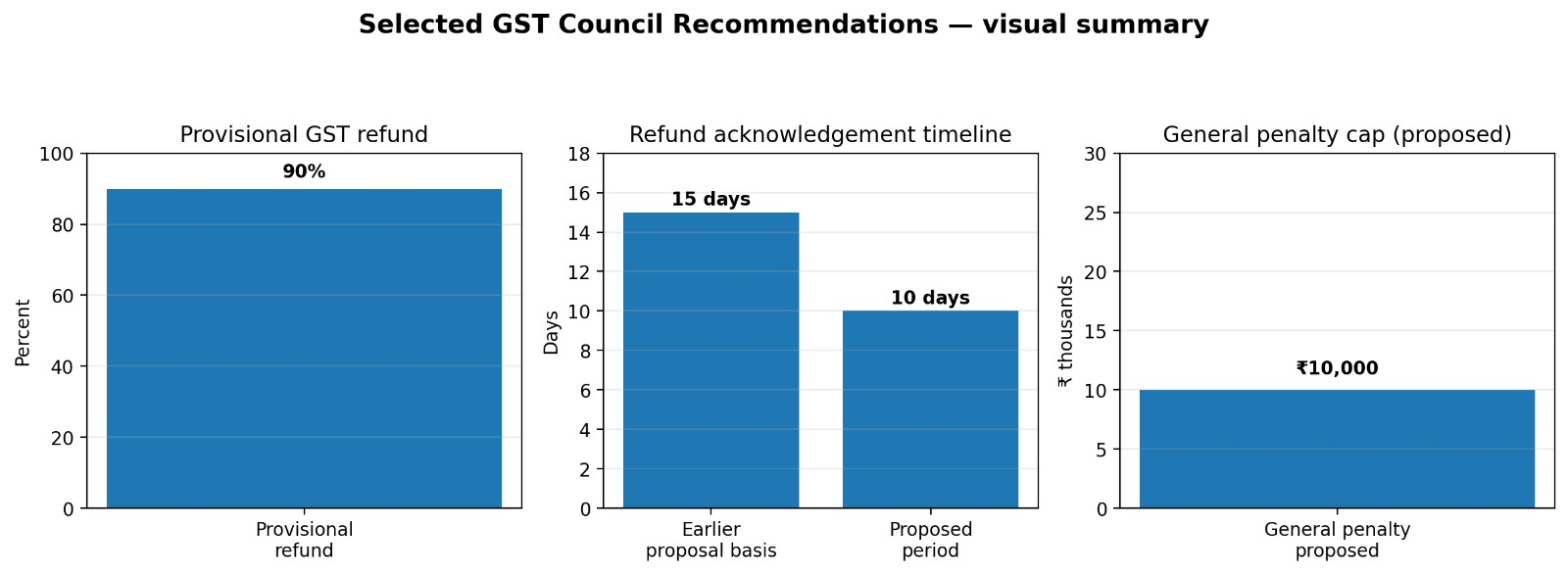
Note: The graphic separates unlike units into different panels. It visualises selected figures and is not a statistical chart or confirmation that the proposals have taken effect.
13 Major Recommendations — Overview Table
| Recommendation | Proposal stated | Likely audience | Practical note |
|---|---|---|---|
| 1. Removal of arrest powers | Proposed omission of CGST Act Section 69 | Businesses and taxpayers | Trust-based enforcement; verify final legislation. |
| 2. Faster GST refunds | 90% provisional refund; acknowledgement timeline 15 to 10 days; automatic excess cash-ledger refunds | Exporters, manufacturers, eligible claimants | Potentially quicker refunds and improved cash flow. |
| 3. Input-service ITC refunds | Refund eligibility proposed for qualifying credit availed from 1 Nov 2026 | Eligible manufacturers / affected businesses | May reduce blocked working capital. |
| 4. Employee health and life insurance ITC | Specified restrictions under Section 17(5) proposed to be removed | Employers | Eligibility depends on final provisions and conditions. |
| 5. Foreign branch transactions / export of services | Proposed change to export-of-services definition under IGST Act | Indian service exporters and businesses with foreign branches | Could affect export classification and related refunds. |
| 6. GST notices below ₹10,000 | Proposed combined-tax threshold of ₹10,000 | Taxpayers with low-value disputes | Could reduce some notices and appeals; not a blanket cancellation. |
| 7. General penalty reduction | Section 125 maximum proposed to reduce from ₹25,000 to ₹10,000 | Businesses and taxpayers | Applies to specified general penalty, not every GST liability. |
| 8. Prosecution threshold | Proposed increase from ₹1 crore to ₹5 crore | Businesses and tax professionals | Does not remove tax, interest or civil penalties. |
| 9. E-commerce seller registration | Simplified mechanism for eligible small suppliers selling through ECOs | Small online sellers | Could ease multi-state expansion, subject to conditions. |
| 10. Movement of goods | Interception proposed to require specific intelligence and Joint Commissioner-level authorisation, subject to exceptions | Transporters, logistics firms, traders | May reduce unnecessary transit stoppages. |
| 11. Standardised notices and orders | Common guidance for notices, adjudication and appeal orders | Taxpayers and tax practitioners | Could improve consistency and natural-justice safeguards. |
| 12. Additional exporter relief | Eligible capital-goods ITC refund spread over 60 months; qualifying credit from 1 Apr 2027 | Exporters and eligible businesses | Could ease unused-credit accumulation over time. |
| 13. ARQP scheme concept | Optional Annual Return Quarterly Payment concept for qualifying turnover up to ₹5 crore and B2C-only supplies | Eligible small businesses | Approved in principle only; await final framework. |
1. Removal of Arrest Powers Under GST
One of the most significant recommendations is the complete withdrawal of arrest powers under GST, through the proposed omission of Section 69 of the Central Goods and Services Tax (CGST) Act.
The recommendation represents a shift towards a more trust-based tax administration. Businesses have often expressed concerns about the consequences of stringent enforcement provisions.
If implemented as recommended, this change would reduce the risk of arrest under the GST provisions concerned. However, businesses must continue to comply with tax laws, maintain accurate records and report transactions correctly.
2. GST Refunds to Become Faster Through Automation
The Council recommended a more automated refund mechanism to reduce delays and manual intervention. Key proposals include:
- 90% provisional refund: Eligible refund claims relating to zero-rated supplies and the inverted duty structure could receive 90% of the claimed amount provisionally, based on system-driven risk assessment.
- Faster acknowledgement: The proposed deadline for issuing a refund acknowledgement or deficiency memo would be reduced from 15 days to 10 days.
- Automatic cash ledger refunds: Refunds of excess balances in the electronic cash ledger would be sanctioned automatically by the system, without officer intervention.
These measures could improve cash flow and reduce the time businesses spend following up on refund applications. For exporters and manufacturers, faster access to eligible refunds could help release funds otherwise tied up in the GST system.
3. GST Refunds on Input Services Under Inverted Duty Structure
The Council recommended expanding the refund of accumulated Input Tax Credit (ITC) under the inverted duty structure. Under the proposal, accumulated ITC on input services would become eligible for refunds for credit availed on or after 1 November 2026.
An inverted duty structure occurs when the GST rate on inputs is higher than the rate on the final product. This can result in accumulated input tax credit that businesses cannot fully utilise against their output tax liability.
The proposed change could provide relief to eligible manufacturers and other affected businesses by reducing blocked working capital. Businesses should maintain proper purchase invoices, reconcile their ITC and monitor the applicable rules before claiming refunds.
TaxPlan Advisor
Stuck GST Refund or Blocked ITC?
A verified Chartered Accountant can review your ITC ledger, reconcile purchases and prepare your refund claim.
4. Input Tax Credit on Employee Health and Life Insurance
The Council recommended removing specified restrictions on ITC under Section 17(5) of the CGST Act, including restrictions relating to employee health and life insurance.
This proposal could allow eligible businesses to claim credit for GST paid on qualifying insurance expenses, subject to the applicable provisions and implementation requirements. For employers, this may reduce the effective cost of providing group insurance benefits.
However, employers should not assume that every insurance premium automatically qualifies. The final legal provisions and conditions will determine the availability and extent of ITC.
5. Foreign Branch Transactions and Export of Services
The Council recommended changes to the definition of export of services under the Integrated Goods and Services Tax (IGST) Act. The proposed amendment would remove the existing condition that the supplier and recipient must not be establishments of the same person for a service to qualify as an export.
This could facilitate refund claims for Indian service providers supplying services to or through their foreign offices and branches. For IT companies, consultants and other service exporters, the recommendation could help clarify the GST treatment of cross-border operations.
Businesses involved in international transactions should review their contracts, invoices and supporting documentation in line with the final amendments.
6. GST Notices Below ₹10,000
To reduce unnecessary litigation and administrative work, the Council recommended a minimum threshold of ₹10,000 for issuing GST show-cause notices. The proposed threshold would cover the combined amount of CGST, SGST/UTGST, IGST and cess involved.
The Council also recommended that pending notices and appeals below this threshold be dealt with as though the minimum threshold had applied when the notice was issued, subject to the proposed statutory provision.
This measure could reduce the compliance burden for smaller tax disputes. It does not mean that taxpayers can ignore GST obligations or that all existing demands below ₹10,000 have already been cancelled. Taxpayers should continue responding to valid notices and obtain professional advice where required.
7. General GST Penalty Reduced from ₹25,000 to ₹10,000
The Council recommended reducing the maximum general penalty under Section 125 of the CGST Act from ₹25,000 to ₹10,000. This proposal is intended to make the penalty framework more proportionate.
The change relates to the specified general penalty provision. It should not be interpreted as a universal cap on every GST penalty, interest charge or tax demand. Businesses should still prioritise timely return filing, accurate invoicing, proper record-keeping and reconciliation of tax liabilities.
8. Prosecution Threshold Increased to ₹5 Crore
The Council recommended increasing the monetary threshold for prosecution under GST from ₹1 crore to ₹5 crore. The proposal forms part of wider recommendations to rationalise GST offences and punishment provisions.
For businesses, this could reduce criminal proceedings for certain cases involving lower amounts, while retaining enforcement against serious tax fraud and evasion. The proposed changes also include narrowing certain offence provisions, including provisions relating to fraudulent ITC claims.
Importantly, a higher prosecution threshold does not eliminate tax liability, interest or civil penalties. Businesses must continue meeting their statutory obligations.
9. Easier GST Registration for E-Commerce Sellers
The Council recommended a simplified registration mechanism for eligible small suppliers selling goods through electronic commerce operators (ECOs). Under the proposed mechanism, qualifying sellers could operate in states where they do not have a physical business presence without having to establish a separate place of business in every such state.
The recommendation includes specific conditions, such as declaring the e-commerce operator’s warehouse in the relevant state as the principal place of business and meeting the applicable ITC-related conditions.
This could help small sellers expand across India through online marketplaces while reducing the cost and complexity of multi-state operations. E-commerce sellers should check their eligibility and the final registration requirements before changing their existing registration arrangements.
10. Smoother Movement of Goods Across States
The Council recommended changes to GST provisions governing the interception, inspection and detention of goods in transit. Under the proposal, vehicles carrying goods could be intercepted only on the basis of specific intelligence and with authorisation from an officer not below the rank of Joint Commissioner.
Inspection and further action would generally be linked to whether the supplier or recipient is located or registered in the state where interception occurs. Transit-state restrictions would apply, subject to specified exceptions, including cases involving missing e-way bills or required documents.
These measures aim to reduce unnecessary stoppages and support smoother movement of goods. Transporters should continue carrying valid invoices, e-way bills and other required documents.
11. Standardised GST Notices and Demand Proceedings
The Council recommended issuing common guidelines for GST notices, adjudication orders and appeal orders. The proposed guidance would address the quality and timely issuance of notices, the proper application of fraud-related provisions and adherence to principles of natural justice, including personal hearings.
Standardised procedures could improve consistency in tax administration and make it easier for taxpayers to understand the allegations or demands raised against them. Maintaining organised documentation and responding to notices within the prescribed timelines will remain essential.
12. Additional Relief for Exporters and Businesses
The Council also recommended wider ITC refund eligibility relating to certain capital goods and input services. For eligible capital-goods ITC relating to zero-rated supplies and the inverted duty structure, the proposed refund mechanism would be spread over 60 months, covering qualifying credit availed on or after 1 April 2027.
These changes could help reduce the accumulation of unused credits and ease working capital constraints. Businesses should review the final provisions carefully before incorporating these proposals into their tax planning.
13. Optional Annual Return Quarterly Payment (ARQP) Scheme for Small Businesses
The Council approved in principle a concept note for an optional Annual Return Quarterly Payment (ARQP) scheme. The proposed scheme is intended for taxpayers with aggregate turnover of up to ₹5 crore in the preceding financial year who are engaged exclusively in supplies to unregistered persons, or B2C supplies.
The proposal could simplify compliance for eligible small businesses by offering an alternative compliance arrangement. However, approval in principle does not mean the scheme is already operational. Businesses should wait for the final framework, eligibility conditions and implementation instructions.
Analysis by Theme
A grouped summary of the 13 recommendations by broad theme.
| Theme | Recommendation count | Recommendations included | Main intended outcome |
|---|---|---|---|
| Refunds & working capital | 3 | 2. Faster refunds; 3. Input-service ITC refunds; 12. Additional exporter relief | Faster access to eligible refunds / reduced blocked credit. |
| ITC & export treatment | 2 | 4. Employee insurance ITC; 5. Foreign branch transactions / export of services | Clarify or widen eligible credit and export treatment. |
| Enforcement, penalties & disputes | 4 | 1. Arrest powers; 6. Low-value notices; 7. General penalty; 8. Prosecution threshold | Rationalise enforcement and reduce selected litigation exposure. |
| Registration & compliance | 2 | 9. E-commerce registration; 13. ARQP concept | Simplify compliance for eligible small sellers and businesses. |
| Goods movement & process consistency | 2 | 10. Movement of goods; 11. Standardised notices and orders | Reduce friction and promote consistent administration. |
Conclusion: What Should Businesses Do Next?
The 57th GST Council Meeting marks an important step towards a more automated, transparent and business-friendly GST system. The key recommendations cover faster refunds, wider ITC eligibility, simplified e-commerce registration, reduced general penalties, a higher prosecution threshold and improved procedures for GST notices and the movement of goods.
For MSMEs, startups, manufacturers, exporters and online sellers, these measures could help reduce administrative costs, improve cash flow and make tax compliance more predictable. The effective date and final conditions of each measure must be verified before a tax position or refund claim is changed. The overall direction is clear: simpler processes, reduced friction and improved ease of doing business — while maintaining accountability under India's GST framework.
Suggested Implementation Checklist for Businesses
- Track official notifications, amendments and effective dates for each recommendation.
- Review refund eligibility, ITC ledgers, purchase invoices and reconciliations before making claims.
- Check e-commerce registration conditions before changing state registrations or declared places of business.
- Keep e-way bills, invoices and transport documents accurate and accessible.
- Review insurance-related ITC only after confirming final statutory conditions.
- Continue responding to notices and meeting filing/payment deadlines; proposals do not automatically cancel obligations.
- Ask a qualified tax professional to assess how final provisions apply to your business.
Official reference: Press Information Bureau, Government of India — Recommendations of the 57th Meeting of the GST Council, published on 8 October 2026. The recommendations described above are proposals and should not be treated as effective law until implemented through notifications or amendments. Verify every proposal against the official release and final notifications before acting.
TaxPlan Advisor
Want a CA to Check How This Affects You?
TaxPlan Advisor matches you with a verified Chartered Accountant for GST registration, filing, refunds and notices — usually within minutes.