
The Alluring ₹59,000 Refund
A client recently approached our CA team with what seemed like sensational news. He had filed his Income Tax Return through an automated online DIY platform, and the portal dashboard was flashing an impressive refund of approximately ₹59,930.
Naturally, he was overjoyed. He believed that substantial excess tax had been withheld by third parties from his earnings during the financial year, and that the Income Tax Department would credit the entire ₹59,000 directly into his bank account within weeks.
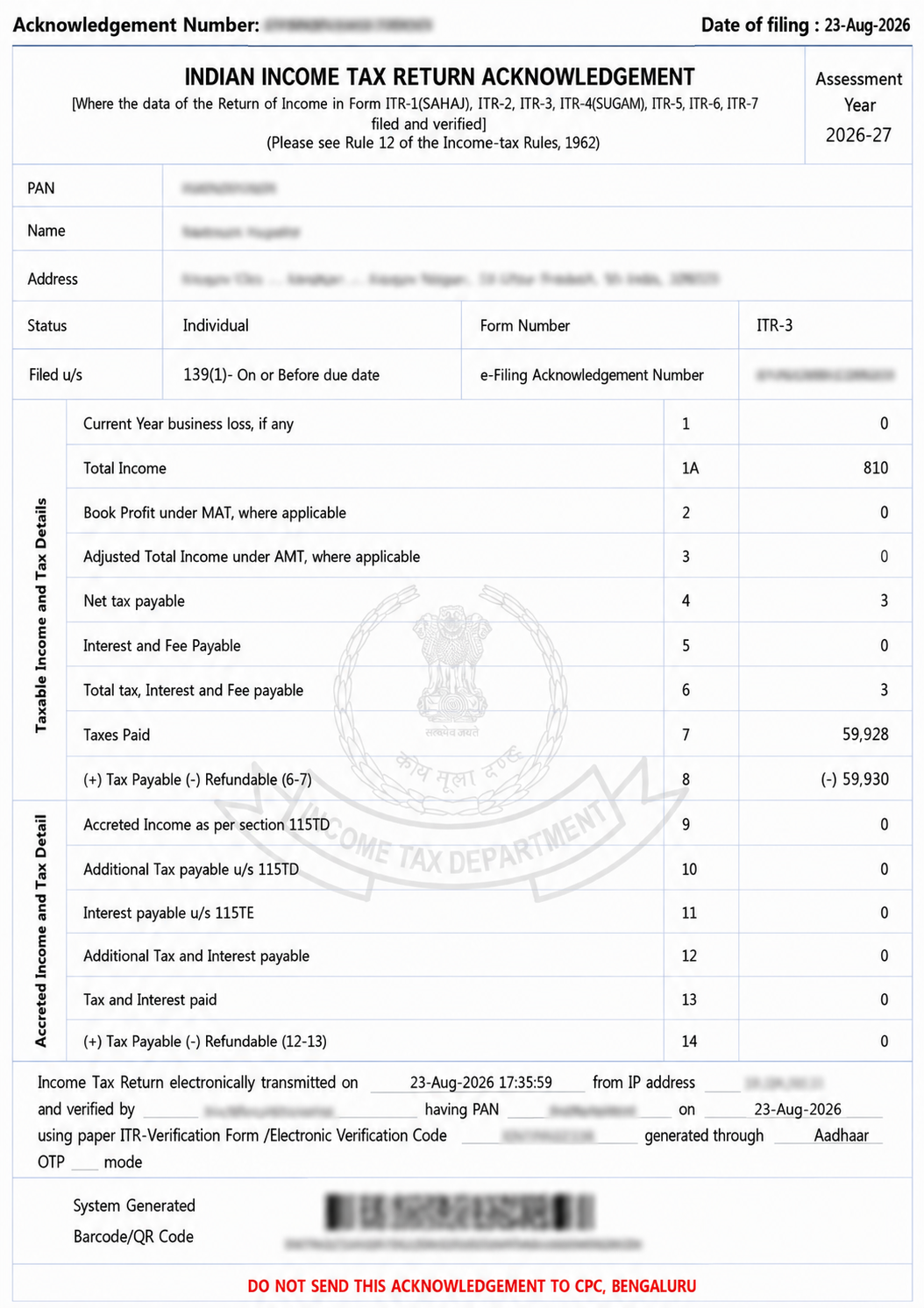
Figure 1: Client's ITR Acknowledgement (ITR-3) — showing reported total income of just ₹810, yet claiming a massive refund of ₹59,930.
However, when our Chartered Accountants examined the acknowledgement and underlying data in detail, the celebration came to an abrupt halt: the refund was not just inaccurate—it was legally indefensible.

Why the Income Tax Portal Calculated a Misleading Refund
At first glance, everything appeared authentic: the government portal showed a refund, the tax credit matched Form 26AS, and the ITR-3 had been successfully e-verified via Aadhaar OTP.
Many taxpayers mistakenly assume that if the official portal calculates a refund, the calculation must be validated and sanctioned by the government. That is a dangerous misconception.
“The Income Tax filing utility is a calculation engine, not an audit barrier. It processes the exact numbers you supply. If you claim full tax credits while omitting the income that generated those credits, the portal will compute an artificial, phantom refund.”
The system checks for mismatches primarily during centralized return processing (CPC Bengaluru) or via subsequent scrutiny notices—not at the moment of clicking “Submit”.
Special Taxation Rules for Online Gaming: Section 115BBJ
Online gaming winnings cannot be lumped into ordinary salary or business income, nor can they benefit from standard deduction slabs or Chapter VI-A deductions (like 80C or 80D).
| Provision | Rule & Tax Treatment |
|---|---|
| Applicable Section | Section 115BBJ (introduced in Finance Act 2023) |
| Flat Tax Rate | 30% flat tax + 4% Cess = 31.2% effective tax |
| Basic Exemption Limit | Not applicable. Tax is payable from Rupee 1 of net winnings. |
| Deduction of Expenses | No expenses or loss set-offs against any other income head allowed. |
| TDS Withholding | Section 194BA requires 30% TDS deduction on net winnings at withdrawal. |
Because the ₹59,813 TDS was exactly equal to 30% of the net gaming winnings, the client had no excess tax paid on that head! When the income was correctly reported alongside other sources, the tax payable matched or exceeded the TDS deducted.
TDS Credit Is Not “Free Money”
Under Rule 37BA of the Income Tax Rules, credit for Tax Deducted at Source is inextricably tied to the income on which it was deducted. You cannot claim credit for the deduction while keeping the revenue hidden from the tax authorities.
- • Declared income: ₹810
- • Omitted ₹1,99,378 gaming winnings
- • Claimed ₹59,813 TDS credit
- • Result: False refund of ₹59,930
- • Report ₹1,99,378 under Section 115BBJ
- • Compute flat tax of 30% + cess = ₹62,206
- • Offset with ₹59,813 TDS credit
- • Result: Self-Assessment Tax due, ZERO refund
Department Scrutiny & Severe Penalty Risks
If this return had remained uncorrected, what would have happened when the Income Tax Department processed the return?
Defective Return or Intimation Notice under Section 143(1)
The automated CPC matching engine flags discrepancy between Form 26AS/AIS income and Schedule OS/winnings.
Interest Liability under Sections 234B and 234C
Mandatory compound monthly interest from the original due date on unpaid advance tax.
Penalty for Misreporting under Section 270A
Suppression of income can trigger a penalty of up to 200% of the tax payable on misreported income.
How TaxPlan Advisor Prevented Disaster
To protect the client from scrutiny notices, high-interest accruals, and statutory penalties, our Chartered Accountants took immediate corrective steps:
- ✓Cross-Audited AIS, TIS, and Form 26AS: Reconciled all gaming withdrawals, freelance income, and food delivery records (Swiggy, Eternal, Sporta Technologies).
- ✓Recalculated True Tax Liability: Segregated the net online gaming income under Section 115BBJ from business income under ITR-3.
- ✓Filed Revised Return under Section 139(5): Substituted the erroneous filing with an accurate, compliant return before the statutory deadline, neutralizing any prospect of penalty.
TaxPlan Advisor
Filing ITR with Crypto, Gaming, or Freelance Income?
Don't rely on automated guesses that could invite tax notices. Have your AIS and Form 26AS reviewed by experienced Chartered Accountants.
Crucial Lessons for Every Taxpayer
This case demonstrates that filing an Income Tax Return is not merely an exercise in maximizing your refund amount—it is about accurately declaring every taxable rupee earned during the year.
1. Always Reconcile AIS
Every TDS credit visible in your 26AS must correspond to a reported income head in your return.
2. Verify Before Cheering
A calculated refund is only as good as the honesty and completeness of the data fed into the software.
3. Consult a Real CA
For non-salary earnings like gaming, freelancing, and capital gains, professional review prevents costly notices.
Frequently Asked Questions
Does a refund calculated on the Income Tax portal guarantee that it is correct?
No. The Income Tax portal’s calculator relies strictly on the figures entered by the taxpayer. If you claim TDS credits without reporting the corresponding income, the portal will compute an artificial refund that will eventually trigger a notice, penalty, and repayment with interest during CPC processing.
How is online gaming income taxed in India?
Under Section 115BBJ of the Income-tax Act, net winnings from online games (Dream11, poker, rummy, fantasy sports, etc.) are taxed at a flat rate of 30% plus 4% Health & Education Cess (effective 31.2%). No basic exemption limit or standard deductions can be claimed against this income.
Can I claim TDS deducted on gaming if I report zero income?
Absolutely not. Under Section 199 and Rule 37BA, credit for tax deducted at source is only available if the corresponding income is offered to tax. Claiming TDS credit while suppressing the underlying earnings is considered misreporting of income under Section 270A.
What should I do if I filed an incorrect return with an inflated refund?
You should immediately file a Revised Return under Section 139(5) before December 31 of the Assessment Year, or file an Updated Return (ITR-U) under Section 139(8A) to pay the rightful tax and prevent severe penal action.