Introduction
Running a company or Limited Liability Partnership (LLP) in India involves more than managing customers, employees and finances. Businesses must also complete statutory filings with the Ministry of Corporate Affairs (MCA), the Registrar of Companies (ROC) and, where applicable, other authorities. These filings keep legal records up to date and provide information about financial performance, management, ownership and certain business transactions.
Annual and periodic ROC filings are easier to manage when they are planned in advance. Missing a due date can lead to additional fees, compliance notices and avoidable administrative work. The exact obligations depend on the entity type, size, financial year, transactions and applicable exemptions. This guide explains common company and LLP filings, the records to prepare and how to build a practical compliance calendar.
What Are Annual and Periodic ROC Filings?
ROC filings are forms and documents submitted electronically through the MCA portal to meet requirements under the Companies Act, 2013, the Limited Liability Partnership Act, 2008 and the rules made under them. Annual filings generally report financial statements, annual returns and other year-end information. Periodic or event-based filings may be required half-yearly, yearly or after a specific event, such as appointing an auditor, changing directors, creating a charge or making certain payments.
Filing requirements are not identical for every entity. A private limited company, One Person Company (OPC), small company and LLP may have different forms, thresholds or deadlines. A compliance calendar should therefore be prepared for the particular entity rather than copied from a generic list.
Common ROC Filings for Companies
1. AOC-4: Filing of Financial Statements
Form AOC-4 is commonly used by companies to file their financial statements and related documents with the ROC. Depending on the company and the applicable rules, attachments may include the balance sheet, statement of profit and loss, cash-flow statement where applicable, notes, auditor’s report and board’s report. The usual statutory deadline is within 30 days of the Annual General Meeting (AGM), subject to the applicable provisions and any special rules.
2. MGT-7 or MGT-7A: Annual Return
Companies generally file an annual return using Form MGT-7, while eligible One Person Companies and small companies use the applicable simplified annual-return form, MGT-7A. The annual return captures information such as the registered office, principal business activities, shareholding, members and management details. The usual deadline is within 60 days of the AGM, subject to the law and applicable exceptions.
3. ADT-1: Appointment of Auditor
Form ADT-1 is used to notify the ROC about the appointment of an auditor where filing is required. The deadline is generally 15 days from the relevant appointment, but the exact requirement should be checked against the company’s circumstances and the current rules. Keep the appointment resolution, auditor consent and eligibility certificate available as applicable.
4. DIR-3 KYC: Director KYC
Individuals holding a Director Identification Number (DIN) must complete the applicable KYC requirement under the rules. MCA guidance states that the KYC filing or service is generally due by 30 September of the immediately following financial year for a DIN allotted up to 31 March of the relevant financial year. The form or web service needed depends on whether it is a first-time filing or a routine update.
5. DPT-3: Return of Deposits and Certain Outstanding Money
Companies within the scope of the applicable rules may need to file Form DPT-3 with information about deposits and specified outstanding money or receipts. Applicability depends on the nature of the amounts and the relevant exclusions. Businesses should reconcile loans, advances and other outstanding balances before deciding whether and how to file.
6. MSME-1: Certain Outstanding Payments to Micro and Small Enterprises
Companies covered by the MSME reporting requirements may need to file half-yearly returns for specified outstanding payments to micro and small enterprise suppliers. The reporting periods and due dates are prescribed by the applicable order. Accounts payable should be reviewed in advance so that qualifying overdue amounts are identified correctly.
7. Event-Based Filings
Some filings are triggered by a corporate event rather than a fixed annual date. Examples can include changes in directors or key managerial personnel, registered office, share capital, charges, allotments or other company details. The relevant form and deadline depend on the event. Inform the compliance team promptly when a change is approved so that a filing deadline is not missed.
Common Annual Filings for LLPs
Form 11: Annual Return
LLPs generally file Form 11 as their annual return, reporting details such as partners, designated partners and contribution information. The usual due date is 30 May following the end of the financial year. Confirm the current MCA requirements and any applicable extensions before filing.
Form 8: Statement of Account and Solvency
LLPs generally file Form 8 to report their statement of account and solvency. The form includes financial information and a declaration about the LLP’s solvency, with certification and attachments as required. The usual due date is 30 October following the end of the financial year. LLPs should prepare their books and supporting records well before the deadline.
ROC Compliance Calendar at a Glance
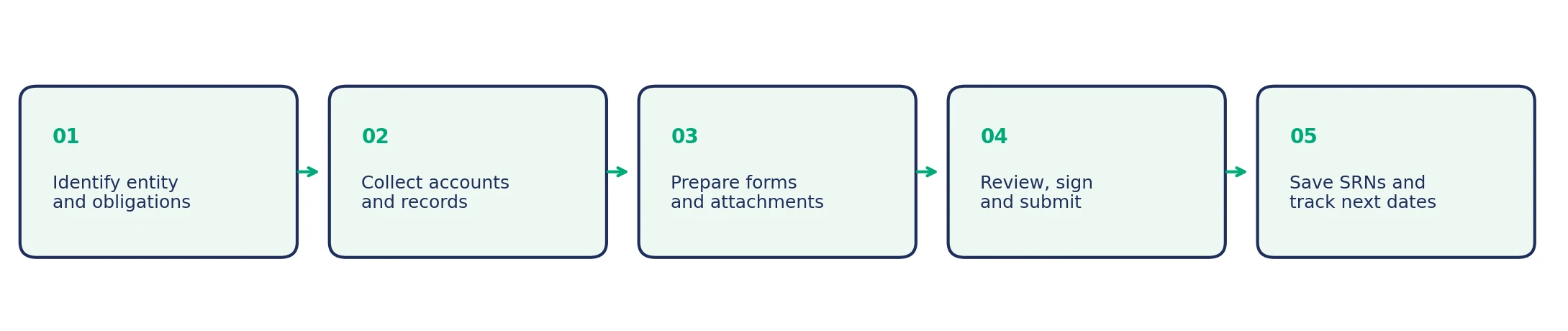
Use this workflow to plan each filing. It is a process illustration, not a date-specific calendar; the applicable deadline must be checked for each entity and financial year.
| Form / filing | Entity / purpose | Common timing | Key preparation |
|---|---|---|---|
| AOC-4 | Company financial statements | Usually within 30 days of AGM | Final accounts, reports, attachments |
| MGT-7 / MGT-7A | Company annual return | Usually within 60 days of AGM | Members, shareholding, management data |
| ADT-1 | Auditor appointment, where required | Generally within 15 days of appointment | Resolution, consent and eligibility documents |
| DIR-3 KYC | DIN holder KYC | Generally by 30 September under applicable rule | Identity/contact details, OTP and DSC where needed |
| DPT-3 | Applicable deposits / specified outstanding money | Annual filing; check current due date | Reconciled loans and outstanding balances |
| MSME-1 | Covered companies reporting qualifying dues | Half-yearly, as prescribed | Supplier classification and ageing report |
| LLP Form 11 | LLP annual return | Usually 30 May | Partner/designated partner and contribution details |
| LLP Form 8 | LLP account and solvency statement | Usually 30 October | Accounts, solvency declaration and certifications |
Documents and Records to Keep Ready
A reliable filing process begins with well-maintained records. Depending on the form, a company or LLP may need:
Certificate of incorporation, CIN or LLPIN, PAN and registered-office details.
Memorandum and Articles of Association for a company, or the LLP agreement for an LLP.
Finalised financial statements, ledgers, trial balance and supporting schedules.
Board and shareholder resolutions, AGM records and minutes, where relevant.
Auditor appointment details, consent and eligibility documents, where applicable.
Current director, designated partner, member and shareholding information.
Details of loans, charges, outstanding supplier dues and other reportable transactions.
Valid Digital Signature Certificates (DSCs), MCA portal access and professional certification where required.
Keep records securely and ensure that the information in the form agrees with the underlying books, resolutions and MCA master data. Inconsistent details can lead to resubmission requests or additional work.
What Happens If ROC Filings Are Delayed?
Late filing may result in additional fees, penalties or other consequences depending on the form, entity type, duration of delay and applicable law. Certain company filings under the Companies Act may attract additional fees calculated on a per-day basis; the exact amount and exceptions must be checked for the relevant form. The figure shown in a service description should not be treated as a universal late fee for every ROC or LLP filing.
Delays can also affect compliance status, financing, due diligence, tenders, business transactions and the ability to complete future filings smoothly. If a deadline has already passed, review the current MCA portal, calculate the applicable fee and seek professional advice on the correct filing route. Do not assume that paying an additional fee removes every possible legal consequence.
How to Build an Effective Compliance Calendar
Identify the entity type — Record whether the entity is a private company, OPC, small company, public company or LLP, along with any special status or exemptions.
Map every applicable obligation — List annual, half-yearly, event-based and transaction-triggered filings. Confirm applicability instead of assuming every form applies to every entity.
Set internal deadlines earlier — Choose internal cut-off dates ahead of statutory due dates so accounts, approvals and attachments can be reviewed in time.
Assign ownership — Nominate a person to collect records, a reviewer to verify the information and an authorised signatory to complete the submission.
Track filing proof — Store the submitted form, challan, Service Request Number (SRN), acknowledgement and any approval or resubmission communication.
Review the calendar regularly — Update the calendar when directors, partners, auditors, registered office, capital, transactions or rules change.
Conclusion
Annual and periodic ROC filings are an essential part of responsible business management in India. Companies must monitor financial statement filing, annual returns, director KYC and other requirements that apply to their circumstances. LLPs should pay particular attention to Form 11 and Form 8, while all entities should review event-based filing obligations whenever a change occurs.
A practical compliance calendar, accurate records, clear responsibility and early preparation can reduce last-minute pressure and help prevent avoidable delays. Taxplan Advisor can help businesses understand their recurring MCA obligations and organise the next steps for their compliance requirements. Confirm the current MCA rules and consult a qualified professional for advice specific to your entity.
Taxplan Advisor
Need Help With This?
Taxplan Advisor can help with ROC and MCA compliance filings.
Official References
- Ministry of Corporate Affairs (MCA)
- MCA Instruction Kit for DIR-3 KYC
- MCA company annual filing forms and instructions
Note: This article provides general information. Filing forms, deadlines, fees and exemptions can change, and special rules may apply. Verify the latest official MCA instructions before acting.
Frequently Asked Questions
What are ROC filings?
ROC filings are statutory forms and documents submitted to the Registrar of Companies through the MCA portal to report required financial, ownership, management or event-related information.
Which forms are commonly filed annually by companies?
Common filings include AOC-4 for financial statements and MGT-7 or MGT-7A for the annual return, along with other forms where applicable.
Do LLPs have annual MCA filings?
Yes. LLPs generally file Form 11 as an annual return and Form 8 as the statement of account and solvency.
Are all ROC filing deadlines the same for every business?
No. Deadlines and applicability depend on the entity type, form, event, financial year and current rules or extensions.
Can late ROC filings be completed?
Many overdue filings can still be submitted through the MCA portal, but additional fees or other consequences may apply. Check the current form-specific requirements before filing.
Why maintain a compliance calendar?
A compliance calendar helps businesses organise records, assign responsibility, meet deadlines and retain evidence of filing.