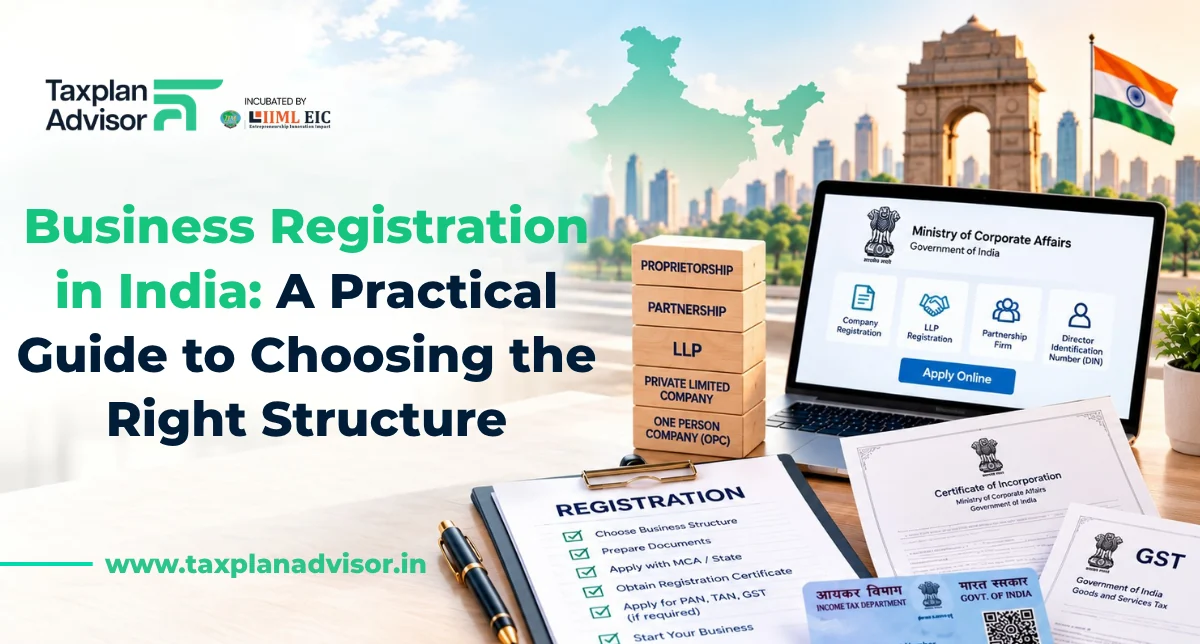
Introduction
Starting a business is an exciting step, but before you begin selling, hiring, or signing contracts, it is important to choose an appropriate legal structure and complete the registrations that apply to your activities. The right setup can help you separate personal and business responsibilities, build credibility with customers, open a business bank account, and meet tax and reporting requirements.
Business registration in India is not one single process for every entrepreneur. A freelancer working alone, a neighbourhood shop, a partnership firm, and a startup seeking investment may need different structures and registrations. The best choice depends on the number of owners, risk exposure, funding plans, compliance capacity, and the nature of the business.
This guide explains common business structures, the documents generally required, the registration journey, likely costs to consider, and practical steps to avoid delays. Requirements can change and may vary by state and business activity, so confirm the latest rules with the relevant government portal or a qualified professional before filing.
Why business registration matters
Formalising a business can make it easier to demonstrate that the enterprise is legitimate, enter into contracts, apply for suitable licences, and maintain separate records. Depending on the structure, registration may also define how ownership is recorded and how decisions are made. It does not automatically guarantee funding, customers, tax savings, or protection from every liability; those outcomes depend on the business and the law.
Credibility: customers, vendors, banks, and potential partners may ask for registration or tax details.
Clear ownership: incorporation or a written partnership arrangement can document roles and responsibilities.
Operational readiness: some activities require additional licences, registrations, or local permissions before trading.
Compliance planning: a proper setup helps establish bookkeeping, tax filings, and annual or periodic obligations from the beginning.
Choose the right business structure
1. Sole proprietorship
A sole proprietorship is commonly considered by an individual running a small business independently. It is comparatively straightforward to start, but the business is not a separate legal person from its owner. The proprietor may be personally responsible for business debts and obligations. There is no single universal incorporation certificate for every proprietorship; proof may instead involve registrations and documents relevant to the business, such as tax registration, local shop permissions, or bank documentation.
2. Partnership firm
A traditional partnership may suit two or more people who want to operate a business together under agreed terms. A partnership deed should clearly describe capital contributions, profit sharing, authority, responsibilities, dispute resolution, retirement, and dissolution. Registration of a partnership firm is handled under the applicable state process. Partners should understand that a traditional partnership generally exposes them to personal liability for firm obligations.
3. Limited Liability Partnership (LLP)
An LLP combines a separate legal identity with limited liability for partners, subject to applicable law and the facts of a case. It can suit professional services and businesses with multiple owners that want a formal structure without using a company form. Incorporation involves the Ministry of Corporate Affairs process, designated partners, required digital and identity documentation, and ongoing filings.
4. Private limited company
A private limited company is often considered by startups planning to bring in investors, issue shares, create a formal ownership structure, or scale operations. It is a separate legal entity, and shareholders’ liability is generally limited to their shareholding, subject to legal exceptions. Incorporation requires following the MCA process and maintaining statutory records and recurring compliance. This structure may be more demanding than a proprietorship in both administration and cost.
5. One Person Company (OPC)
An OPC can be relevant to an eligible individual who wants a company structure with one member. Eligibility, nominee requirements, incorporation steps, and compliance obligations must be checked against current rules. It can offer a formal corporate structure, but may not be the best fit for every small or early-stage business.
How to decide between these options
Do not select a structure only because it is described as the cheapest or fastest. Compare the business’s current needs with its likely next stage. A solo consultant with limited risk may prioritise simplicity; a business with co-founders needs clear ownership and decision-making; a venture expecting equity investment may need a company structure. Consider professional advice if contracts, employees, intellectual property, regulated activity, or material financial exposure are involved.
Number of owners and how ownership will be documented.
Personal liability and the risk profile of the activity.
Plans to raise investment, issue shares, or add partners.
Expected revenue, accounting needs, and ability to handle recurring filings.
Customer, lender, tender, marketplace, or industry requirements.
Documents commonly required
Document requirements depend on the structure, the owners, the registered address, and the filing route. Commonly requested items can include:
PAN and identity proof of the proprietor, partners, directors, or designated partners, as applicable.
Address proof for individuals and the proposed registered office.
Photographs and contact details where required by the process.
Proof of business address, such as a utility bill and ownership or rent/lease documentation; owner consent may be needed.
Partnership deed for a partnership, or incorporation-related declarations and constitutional documents for an LLP or company.
Digital Signature Certificates and Director Identification Numbers where required for MCA filings.
Business activity details, proposed name, capital or contribution information, and ownership details.
Make sure names, addresses, and identity details are consistent across documents. A mismatch, expired proof, unclear address consent, or an unsuitable proposed name can result in resubmission or delay. Do not share OTPs or digital-signature credentials with an untrusted intermediary.
Step-by-step business registration process
Step 1: Define the business activity
Describe what the business will actually do, where it will operate, who its customers are, and whether the activity needs a sector-specific licence.
Step 2: Select the legal structure
Compare ownership, liability, investment plans, administrative work, and future changes before deciding.
Step 3: Finalise the name and address
Check applicable naming rules and availability where relevant. Confirm that the proposed registered address can be supported by acceptable proof and consent.
Step 4: Prepare documents
Collect identity, address, ownership, and business documents. Check the latest requirements for the selected route.
Step 5: Submit the appropriate application
Use the relevant official portal or state/local authority. Company and LLP incorporation processes generally use the Ministry of Corporate Affairs system; other registrations depend on the business type and location.
Step 6: Review the approval and records
Verify the spelling of the business name, address, registration identifiers, and the details stated in the certificate or approval.
Step 7: Complete follow-on registrations
Depending on eligibility and activity, assess PAN/TAN, GST, Shops and Establishments, professional tax, Udyam/MSME, FSSAI, import-export, labour, or municipal requirements. These are not automatically required for every business.
Step 8: Set up ongoing compliance
Create an accounting process, retain invoices and agreements, track due dates, and understand annual or periodic returns that apply to the chosen structure.
Business registration and GST: are they the same?
No. Business formation and GST registration are separate questions. A company or LLP may be incorporated without every business automatically needing GST registration on day one. GST registration depends on factors such as turnover thresholds, the nature of supplies, interstate or other specified transactions, and exceptions under current law. Conversely, some proprietorships may need GST registration even though they do not have a company incorporation certificate. Check current GST rules and your specific circumstances before deciding.
Other registrations also serve different purposes. Udyam registration relates to MSME classification and benefits, while local shop registrations and sector licences address different legal or operational requirements. Avoid buying a package that promises every registration without checking which ones apply to your activity.
How much does business registration cost?
There is no single fee that applies to every business registration. The total may include government filing fees, stamp duty where applicable, digital signature costs, professional assistance, and later compliance expenses. The amounts depend on the chosen structure, state, authorised or contribution capital where relevant, number of owners, and the service provider. Ask for an itemised quote that separates government charges from professional fees and identifies any recurring annual costs.
The lowest initial quote is not always the lowest total cost. Before selecting a service, confirm exactly what is included, which government forms will be filed, whether resubmissions are covered, what documents you will receive, and whether ongoing filings are included or billed separately.
Common mistakes to avoid
Choosing a structure without considering personal liability or future investors.
Using an unclear or incomplete partnership deed or founder agreement.
Submitting inconsistent names, addresses, or identity information.
Assuming GST, Udyam, local licences, and incorporation are the same registration.
Ignoring annual returns, tax filings, accounting, or changes in directors and ownership.
Paying an intermediary without a written scope, receipt, and clear deliverables.
Using a business name before checking relevant availability and trademark considerations.
When should you seek professional assistance?
Professional support can be useful when the business has multiple founders, foreign ownership, complex shareholding, regulated operations, employees, material contracts, or uncertainty about GST and other tax registrations. An advisor can help map the applicable registrations, prepare documents, explain timelines and fees, and establish a compliance calendar. However, the business owner should retain copies of every application, certificate, agreement, and payment receipt.
For a simple business, you may be able to complete some registrations directly through official portals. Whether you use a professional or self-file, verify the current government requirements and never treat an approval timeline as guaranteed.
How Taxplan Advisor can help
Taxplan Advisor helps business owners connect with professionals for registration and compliance support. If you are choosing between a proprietorship, partnership, LLP, or company, prepare a short summary of your business activity, owners, location, expected turnover, and growth plans before seeking guidance. This makes it easier to identify the registrations that may apply and understand the next steps.
Explore the Business Registration service page: https://www.taxplanadvisor.in/services/registrations. Ask for a clear scope of work, a breakdown of applicable government and professional fees, expected document requirements, and any ongoing compliance support before proceeding.
Conclusion
The right business registration starts with a clear understanding of your ownership, liability, business activity, and plans for growth. Choose the structure that fits the business rather than simply selecting the most popular option, prepare consistent documents, complete only the registrations that apply, and plan for ongoing compliance from the beginning. For help mapping the registration process and related tax requirements, visit Taxplan Advisor’s Business Registration page and discuss your needs with a qualified professional.
Taxplan Advisor
Need Help With This?
Taxplan Advisor can help you choose and register the right business structure.
Official sources and references
Frequently Asked Questions
Can I register a business online in India?
Many business registrations can be initiated online, but the portal, documents, approvals, and follow-up steps depend on the selected structure and activity. Some state or local processes may differ.
Which registration is best for a small business?
There is no universal answer. A proprietorship may be practical for a solo owner, while a partnership, LLP, or company may suit different ownership, liability, and growth needs. Compare the trade-offs before choosing.
Does every business need GST registration?
No. GST applicability depends on current legal rules and the facts of the business. Review turnover, supply type, location, and relevant exceptions.
Can I change my business structure later?
A business may be able to restructure, but the process can involve new registrations, transfers of assets or contracts, tax considerations, and compliance costs. It is worth planning ahead before starting.
How long does registration take?
Timelines vary with the structure, completeness of documents, government processing, name approval, and any resubmissions. Treat any estimate as indicative rather than a guarantee.