
A simple guide to the second advance-tax instalment for Tax Year 2026–27 — who needs to pay, how much was due, what happens after the deadline, and how to pay the shortfall correctly.
Quick answer
If you were required to pay advance tax by 15 September 2026 and missed the deadline, do not wait for the next instalment. Recalculate your estimated tax for Tax Year 2026–27, pay the shortfall as soon as possible through the Income Tax e-Filing portal, and keep the challan receipt. Interest may apply on the shortfall, but paying earlier can prevent the unpaid amount from continuing into later instalments.
What Was Due on 15 September 2026?
For Tax Year 2026–27, most taxpayers who are liable to pay advance tax should have paid at least 45% of their estimated annual advance-tax liability by 15 September 2026. This 45% is cumulative — it includes the amount already paid by 15 June.
So, if your estimated advance-tax liability for the full year is ₹1,20,000, the cumulative amount expected by 15 September is ₹54,000. If you had already paid ₹18,000 in June, the second instalment would generally be another ₹36,000.
Important for 2026
Advance tax on income earned from 1 April 2026 onward falls under the Income-tax Act, 2025. The Income Tax Department confirms that advance-tax liability for Tax Year 2026–27 is governed by the new Act. The overall payment structure remains broadly the same as before.
What Is Advance Tax?
Advance tax simply means paying income tax during the year in which you earn the income instead of waiting until you file your return later. It is often called “pay as you earn” tax.
For salaried employees, a large part of tax is normally covered through TDS deducted by the employer. But advance tax can still become relevant when you have additional income on which enough tax has not already been deducted, such as:
-
Freelance or consulting income
-
Business or professional income
-
Rental income
-
Interest from fixed deposits, bonds or other investments
-
Capital gains from shares, mutual funds, property or other assets
-
Dividend or other taxable income
-
Multiple sources of income where total TDS is not enough
Under Section 404 of the Income-tax Act, 2025, advance tax is payable when the advance-tax amount computed for the year is ₹10,000 or more.
Who Needs to Pay Advance Tax?
You should check your advance-tax liability if your estimated tax payable for the year — after reducing eligible TDS/TCS and other applicable credits — is ₹10,000 or more.
This can apply to individuals as well as businesses and entities. Typical examples include:
-
A salaried employee who also earns large capital gains or rental income
-
A freelancer whose clients do not deduct enough TDS
-
A professional with consulting receipts
-
A proprietor or business owner earning taxable profits
-
An investor with taxable gains and other income
-
A company, firm or other taxable entity with current-year tax liability
Who Usually Does Not Need to Pay?
Two common situations are:
1. Your computed advance-tax liability for the year is below ₹10,000 after considering eligible TDS/TCS and credits.
2. You are a resident individual aged 60 years or more and you do not have income chargeable under “Profits and gains of business or profession”. The new Act continues this senior-citizen exception.
Do not assume that being salaried automatically removes advance-tax liability. If tax deducted from salary does not cover tax on your other income, an advance-tax payment may still be required.
Advance Tax Due Dates for Tax Year 2026–27
For regular advance-tax taxpayers, Section 408 of the Income-tax Act, 2025 provides the following cumulative instalment schedule:
| Due date | Cumulative amount to be paid | What it means |
|---|---|---|
| 15 June 2026 | At least 15% | First instalment |
| 15 September 2026 | At least 45% | Total paid by this date should reach 45% |
| 15 December 2026 | At least 75% | Total paid by this date should reach 75% |
| 15 March 2027 | 100% | Full estimated advance-tax liability |
Advance-tax payment milestones
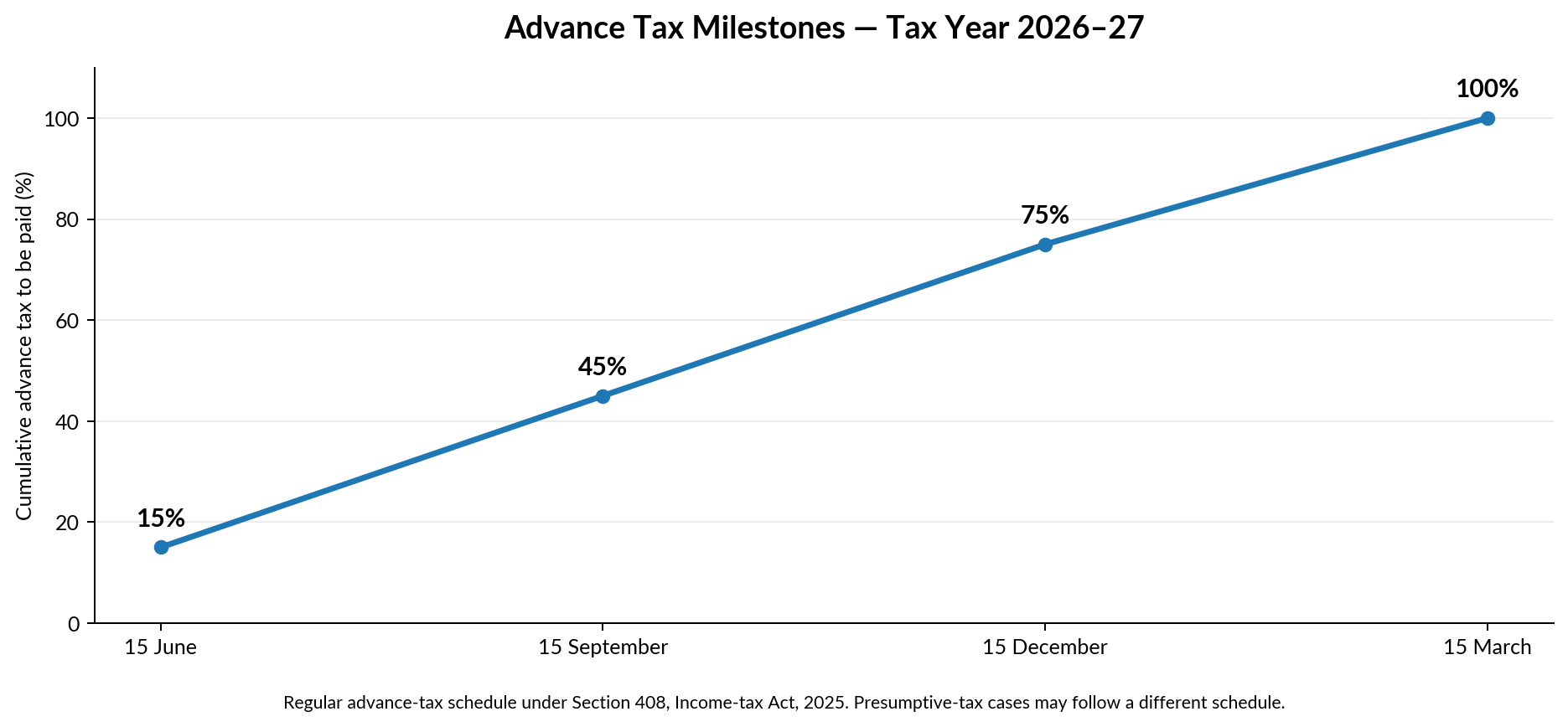
Figure 1: Cumulative advance-tax milestones for regular taxpayers in Tax Year 2026–27.
Presumptive taxation can follow a different schedule
The Income Tax Department states that taxpayers covered by the specified presumptive taxation scheme under Section 58 can discharge the entire advance-tax liability in one instalment on or before 15 March. If you use presumptive taxation, check your exact category before applying the regular four-instalment schedule.
How Much Should You Have Paid by 15 September?
The key point is that 45% is a cumulative target. You do not pay 45% again on top of the June instalment.
Simple formula
Amount to be paid by 15 September = 45% of estimated annual advance tax − advance tax already paid earlier in the year.
Example:
| Calculation | Amount |
|---|---|
| Estimated advance-tax liability for the full year | ₹1,20,000 |
| 45% cumulative target by 15 September | ₹54,000 |
| Advance tax already paid by 15 June | ₹18,000 |
| Second instalment normally required by 15 September | ₹36,000 |
If your income estimate has increased since June, you should use the latest reasonable estimate rather than blindly repeating the earlier calculation. Advance tax is based on current estimated income, and the law allows taxpayers to increase or reduce later instalments when their estimate changes.
What Happens If You Missed the Deadline?
Missing 15 September does not mean you should stop paying advance tax for the year. The practical response is to correct the shortfall as early as possible.
1. Re-estimate your total taxable income for Tax Year 2026–27.
2. Calculate the expected income tax for the year under the tax regime applicable to you.
3. Reduce eligible TDS/TCS and other relevant credits while computing the advance-tax amount.
4. Compare 45% of the annual advance-tax liability with the amount actually paid by 15 September.
5. Pay the shortfall through e-Pay Tax as soon as possible.
6. Save the challan receipt and include the payment when you recalculate the December instalment.
Do not wait simply because 15 September has passed
A payment made after the due date may not erase interest already triggered for a missed instalment, but paying now helps reduce the unpaid tax that would otherwise continue into later milestones. Waiting until December can make the position worse if the liability is already known.
How Interest Can Apply After Missing Advance Tax
The usual consequence of an advance-tax shortfall is interest rather than a flat “late filing penalty”. Under the Income-tax Act, 2025, the relevant provisions are Section 425 for deferment of advance-tax instalments and Section 424 for broader default or insufficient advance tax.
The Income Tax Department states that the interest framework has not materially changed under the new Act. Section 424 generally uses 1% per month or part of a month in the specified default period where advance tax has not been sufficiently paid, while Section 425 applies 1% or 3% to instalment shortfalls depending on the relevant milestone and conditions.
For a September instalment shortfall, interest can therefore apply even if you later pay the tax. The exact amount depends on the final returned income, the amount paid by each milestone, TDS/TCS credits, and any exception that applies to your income.
Why we are not giving a one-line penalty number
Advance-tax interest is not always “3% of whatever you forgot”. The law contains threshold and exception rules, and the final computation depends on your actual tax due and payments. For example, special treatment can apply to certain income that could not reasonably be estimated earlier, such as capital gains, dividend income or income from a new business/profession, provided the related tax is paid in the remaining instalments or within the permitted time.
Simple Worked Example: You Paid Too Little by 15 September
Assume your estimated advance-tax liability for Tax Year 2026–27 is ₹1,20,000 after considering eligible TDS/TCS.
| Item | Amount |
|---|---|
| Required cumulative amount by 15 June (15%) | ₹18,000 |
| Required cumulative amount by 15 September (45%) | ₹54,000 |
| Amount actually paid by 15 September | ₹30,000 |
| Apparent shortfall against the 45% milestone | ₹24,000 |
In this situation, you should not wait until 15 December just because the second instalment date is over. Recheck the estimate and pay the appropriate shortfall now. When December arrives, calculate the 75% cumulative target using your latest income estimate and reduce all advance tax already paid.
The exact Section 425 interest should be computed using the final facts and the applicable statutory rules. The objective of the example is to show how the cumulative shortfall is identified, not to replace a formal interest calculation.
How to Pay the Missed Advance Tax Now
For payments relating to Tax Year 2026–27, the Income Tax Department has introduced the new-act payment flow. You can pay through the e-Filing portal using e-Pay Tax.
1. Go to the Income Tax e-Filing portal and open e-Pay Tax. You can use the service after login, and the portal also provides a pre-login payment route.
2. Select the Income Tax Act, 2025 for payments relating to Tax Year 2026–27.
3. Choose the applicable income-tax/corporation-tax payment tile and select Advance Tax as the type of payment.
4. Confirm Tax Year 2026–27 and enter the correct tax breakup.
5. Generate the Challan Reference Number (CRN) and complete payment using an available mode such as net banking, debit card, payment gateway/UPI where available, RTGS/NEFT, or another supported option.
6. Download and save the challan receipt after successful payment.
Do not select the wrong year
For current income earned from 1 April 2026 to 31 March 2027, the portal uses the Income-tax Act, 2025 and Tax Year 2026–27. Older liabilities may still belong to the Income-tax Act, 1961 and an Assessment Year. Check the period before paying.
Common Mistakes to Avoid
| Mistake | Why it causes trouble |
|---|---|
| Waiting until December after missing September | It can leave a known tax shortfall unpaid for longer and may increase interest exposure. |
| Treating 45% as an additional instalment | The 45% target is cumulative; subtract what you already paid. |
| Ignoring TDS/TCS | Advance tax is computed after considering eligible tax already deductible/collectible at source. |
| Using only salary income in the estimate | Capital gains, rent, interest, freelance and business income can change the liability. |
| Choosing the wrong Act or tax period in e-Pay Tax | Tax Year 2026–27 payments fall under the Income-tax Act, 2025. |
| Not saving the challan receipt | The receipt is important when reconciling your tax payments and filing the return. |
What If Your Income Changes Later?
Advance tax is based on estimated current-year income, so your calculation can change during the year. A freelancer may win a new project in October. An investor may sell property in November. A business may have a much stronger or weaker quarter than expected.
The new Act expressly allows a taxpayer who has already paid one or more instalments to increase or reduce the amount payable in the remaining instalments so that the advance-tax position reflects the latest estimate.
That means you should review your calculation again before 15 December and again before 15 March. Do not treat the June or September estimate as fixed for the entire year.
Taxplan Advisor
Not sure whether your September payment was enough?
Taxplan Advisor can help you estimate current-year income, reconcile TDS/TCS and advance-tax payments, and identify the amount to be paid before the next milestone.
Final Thoughts
Missing the 15 September advance-tax date is a problem you can still act on. The most important thing is not to ignore it until return-filing season.
Estimate your current-year income, check how much tax will already be covered by TDS/TCS, compare your payments with the 45% September milestone, and pay the required shortfall as early as possible. Then review the calculation again before the 15 December and 15 March milestones.
For Tax Year 2026–27, remember that these payments now sit under the Income-tax Act, 2025. Using the correct Act and Tax Year on the e-Filing portal is just as important as paying the correct amount.
Taxplan Advisor
Need help calculating your advance tax?
Get your income, TDS/TCS and current tax payments reviewed before the next instalment.
Official Sources & References
The article has been prepared using official Income Tax Department guidance available as of 15 September 2026. Key references:
-
Income Tax Department — Tax Payments FAQs (Income-tax Act, 2025)
-
Income Tax Department — Section 408: Instalments of advance tax and due dates
-
Income Tax Department — Section 404: Conditions of liability to pay advance tax
Editorial note
Tax law and portal procedures can change through notifications, rules, Finance Acts and system updates. Recheck official guidance before publishing or materially updating this article. This article is general information and not a substitute for advice based on a taxpayer’s facts.
Frequently Asked Questions
Can I still pay advance tax after 15 September 2026?
Yes. If you missed the due date, you can still pay the appropriate advance-tax amount. Paying after the deadline does not necessarily remove interest already applicable to the missed instalment, but it is generally better to correct a known shortfall rather than wait for the next deadline.
Is there a fixed penalty for missing the September advance-tax deadline?
The normal consequence is interest on the relevant shortfall under the advance-tax interest provisions, not a single fixed late-payment penalty. The exact interest depends on your final tax liability and payment history.
What percentage of advance tax was due by 15 September?
For regular advance-tax taxpayers, the cumulative target is at least 45% of the annual advance-tax liability by 15 September. Any amount already paid in June is counted toward this 45%.
If I paid nothing in June, can I pay 45% in September?
Yes, the September milestone is cumulative. However, a June shortfall may already have interest consequences. If September has also been missed, calculate and pay the appropriate amount as soon as possible.
Do salaried employees need advance tax?
They can. Salary TDS often covers most tax, but advance tax may arise if you have significant capital gains, rent, interest, freelance income or other taxable income and total TDS is not enough.
Do senior citizens have to pay advance tax?
A resident individual aged 60 or more who does not have income chargeable under profits and gains of business or profession is generally outside the advance-tax requirement under Section 403(3). A senior citizen with business/professional income should check the normal rules.
Which law applies to the September 2026 advance-tax instalment?
For income earned during Tax Year 2026–27, the Income-tax Act, 2025 applies. The Income Tax Department specifically confirms that advance tax for FY/Tax Year 2026–27 is governed by the new Act.
Should I wait until I know my exact annual income?
No. Advance tax is based on a reasonable estimate of current income. You can revise the estimate and adjust later instalments if your income changes.
Can capital gains create advance-tax liability even if they happen late in the year?
Yes. Capital gains can increase advance-tax liability. The law also contains relief from instalment interest in certain cases where specified income such as capital gains could not be estimated earlier and the related tax is paid in the remaining instalments or within the permitted period.