OPC Registration Process Graph
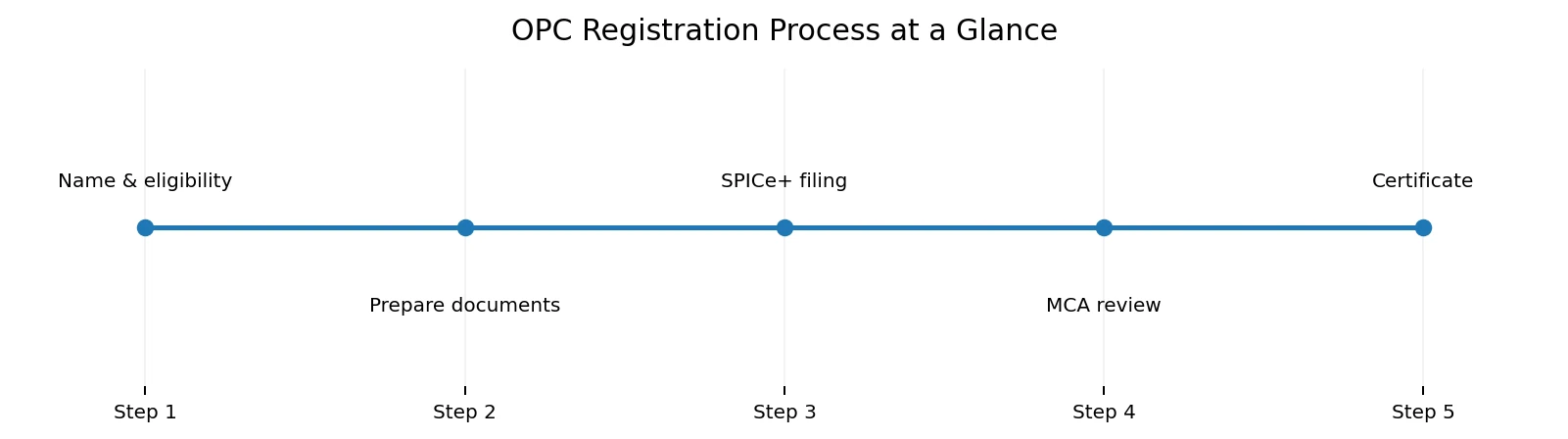
Note: This is a process-stage illustration, not a measured timeline. Actual processing time depends on document readiness and MCA review.
Quick Reference Table (Pivot-Style Summary)
| Topic | Key Point | Action / Note |
|---|---|---|
| Eligibility | One eligible individual member; nominee required | Verify current MCA rules |
| Core filing | SPICe+ with linked forms as applicable | Check current MCA portal requirements |
| Documents | PAN, ID/address proof, nominee consent, office proof | Prepare clear, matching documents |
| Indicative timeline | Often around 10–15 working days after documents are ready | Not guaranteed; delays may occur |
| INC-20A | Generally due within 180 days for companies with share capital | Confirm applicability and file on time |
| First auditor | Appoint within 30 days of incorporation | Track statutory deadline |
| Annual compliance | Accounting, audit and MCA filings may apply | Maintain a compliance calendar |
| GST | Depends on business facts and applicable GST law | Assess separately; not automatic for every OPC |
Introduction
Starting a business independently is easier when you choose the right business structure. If you want to operate a business with a single owner while maintaining a separate legal identity, a One Person Company (OPC) can be a suitable option.
Under the Companies Act, 2013, an OPC allows a single member to establish a private company with limited liability, subject to applicable legal requirements. It is particularly relevant for solo entrepreneurs, consultants, freelancers and small business owners who want a formal corporate structure.
In this guide, we explain One Person Company registration in India, including eligibility, required documents, the registration process, costs, timelines and post-incorporation compliance.
What Is a One Person Company (OPC)?
A One Person Company is a type of private company that can be incorporated with one member. Unlike a sole proprietorship, an OPC has a separate legal identity from its owner.
This means the company can own assets, enter into contracts and conduct business in its own name. The member's liability is generally limited to the unpaid amount on their shares, subject to applicable law and exceptions.
For example, if a freelance consultant wants to establish a formal business, they may consider OPC registration to separate their business operations from their personal activities.
Quick answer: An OPC is a company structure designed for a single member who wants the benefits of incorporation and limited liability without having multiple shareholders.
Who Can Register a One Person Company in India?
Eligibility must be checked under the Companies Act, 2013 and the applicable Companies (Incorporation) Rules.
Generally, the following points are important: • The sole member must be a natural person and an Indian citizen. • An Indian citizen may qualify whether resident in India or otherwise, subject to the applicable rules. • A nominee must be appointed with their prior written consent. • A minor cannot become the member or nominee of an OPC. • The same individual cannot incorporate or become a nominee in more OPCs than the rules permit. • The proposed company must have a lawful business objective.
An OPC may suit entrepreneurs who want to operate independently while building a company with a recognised legal structure. Before proceeding, verify the latest eligibility requirements and restrictions with the Ministry of Corporate Affairs (MCA) or a qualified professional.
Benefits of One Person Company Registration
Choosing the right business structure can influence your company's legal responsibilities, credibility and future growth.
- Separate legal identity: An OPC is legally distinct from its member. The company can enter into contracts, own property and carry out business activities in its own name.
- Limited liability protection: The member's liability is generally limited to their shareholding obligations. However, limited liability does not protect against every circumstance, including certain statutory liabilities or fraud.
- Single ownership: You can establish and operate the company without bringing in another shareholder. This structure offers greater ownership control to an individual entrepreneur.
- Improved business credibility: An incorporated company may help establish credibility with customers, vendors, financial institutions and business partners. Actual credibility will depend on the company's operations and track record.
- Business continuity: The nominee mechanism provides a framework for membership succession if the sole member dies or becomes incapable of contracting, as provided by law.
- Scope for future expansion: An OPC can be converted into another eligible company structure in accordance with the applicable legal procedure. This can provide flexibility as the business grows.
Documents Required for OPC Registration
Preparing accurate documents in advance can help reduce delays during company incorporation. The following documents are commonly required, depending on the applicant's circumstances and the MCA filing requirements.
Documents of the member and nominee: • PAN card of the proposed member. • Aadhaar or another acceptable identity document. • Proof of residential address. • Passport-size photographs, where required. • Email address and mobile number. • Nominee's identity and address proof. • Nominee's consent in Form INC-3.
Registered office documents: • Recent electricity bill, telephone bill or another acceptable utility bill. • Proof of ownership or occupancy, as applicable. • No-Objection Certificate (NOC) from the property owner, where required. • Rent or lease agreement, if applicable.
Business and incorporation details: • Proposed company names in order of preference. • Description of the intended business activity. • Memorandum of Association (MOA). • Articles of Association (AOA). • Applicable declarations and incorporation forms.
The precise document requirements may vary according to the registered office arrangement, proposed business activity and information already available through the MCA system.
How to Register an OPC in India: Step-by-Step Process
The incorporation process is completed through the Ministry of Corporate Affairs portal.
Step 1: Select a company name. Choose a unique name that reflects your business activity and complies with MCA naming requirements. Check whether the proposed name conflicts with existing company names or registered trademarks.
Step 2: Arrange digital signatures. The relevant individuals need a Digital Signature Certificate (DSC) for digitally signing applicable incorporation documents.
Step 3: Prepare incorporation details. Finalise the proposed registered office address, business objectives, share capital details, member information and nominee details.
Step 4: Complete the SPICe+ application. The SPICe+ incorporation process is used to submit the relevant company registration details. The applicable linked forms may include e-MOA, e-AOA, nominee consent in Form INC-3 and AGILE-PRO-S. The exact forms and attachments depend on the proposed company's circumstances and the current MCA filing process.
Step 5: Submit the application to MCA. Submit the completed application with the required documents and applicable fees. The Registrar of Companies may examine the application and request clarification or corrections if necessary.
Step 6: Receive the Certificate of Incorporation. Once the application is approved, the company receives its Certificate of Incorporation and Corporate Identity Number (CIN). Applicable PAN, TAN and other linked registrations are processed according to the relevant incorporation and registration procedures.
Important: Company incorporation does not automatically mean every business-specific licence or registration has been obtained. GST registration and other approvals may be required separately, depending on the business.
What Is the Cost of OPC Registration in India?
The cost of One Person Company registration depends on several factors, including government filing fees, stamp duty, authorised capital, digital signature requirements and professional service charges.
Additional costs may arise from documentation, registered office arrangements and other services. There is no single universal registration price that applies to every OPC. Request an itemised quotation that separates government charges from professional fees before proceeding.
How Long Does OPC Registration Take?
The time required for OPC incorporation depends on document readiness, name availability, application accuracy and MCA processing.
A straightforward application may be completed within approximately 10–15 working days after the documents are ready, but this is an indicative estimate rather than a guaranteed timeline. Delays can occur if the proposed name is unavailable, supporting documents contain discrepancies or the authorities request additional information.
Preparing accurate documents and reviewing the application before submission can help minimise avoidable delays.
Important Compliance Requirements After OPC Registration
Incorporation is only the beginning. An OPC must also meet its applicable legal and financial reporting obligations.
- Appoint the first auditor: The Board must appoint the first statutory auditor within 30 days of incorporation, in accordance with Section 139(6) of the Companies Act, 2013.
- File Form INC-20A: A company having share capital must generally file the declaration of commencement of business in Form INC-20A within 180 days of incorporation. The declaration confirms that the subscribers have paid for their agreed shares. The company must also satisfy the applicable registered-office verification requirement. Until the relevant conditions are met, it cannot commence business or exercise borrowing powers as restricted under Section 10A.
- Maintain accounting records: The company must maintain appropriate books of account and financial records as required by law, even if its business activity is limited.
- Complete annual filings: An OPC must comply with applicable annual financial statement and annual return filing requirements, including the relevant MCA forms. It is not exempt from statutory audit merely because it has a single member or low turnover.
- Meet income tax and GST obligations: The company must evaluate its income tax filing requirements and any applicable GST, TDS and other statutory obligations.
Compliance reminder: Track deadlines from the relevant triggering date and verify current requirements with a qualified professional. Missing a statutory deadline can result in additional fees, penalties or other consequences.
OPC vs Sole Proprietorship: Which Is Better?
A One Person Company and a sole proprietorship are not the same structure.
• Legal identity: An OPC is separate from its member; a sole proprietorship is not separate from its proprietor. • Ownership: An OPC has one member; a sole proprietorship has one proprietor. • Liability: An OPC generally offers limited liability subject to law; a proprietor generally has unlimited personal liability. • Registration: An OPC requires MCA company incorporation; a sole proprietorship does not have an equivalent company incorporation process. • Compliance: An OPC has company-level statutory obligations, while a sole proprietorship is generally simpler, depending on its activity.
The right option depends on your business goals, risk exposure, budget and willingness to manage statutory compliance.
Conclusion: Start Your Business with the Right Structure
A One Person Company can be a practical option for an entrepreneur who wants single-member ownership, a separate legal identity and limited liability protection. However, incorporation also brings ongoing accounting, audit, tax and statutory filing responsibilities.
Before registering, evaluate your business model, expected growth, compliance budget and long-term plans. Proper preparation can help you select a suitable structure and avoid unnecessary delays.
Need assistance with business registration? Taxplan Advisor can help you explore company incorporation and other business registration services based on your requirements.
Visit: https://www.taxplanadvisor.in/services/registrations
Disclaimer: This article provides general information and is not a substitute for legal, tax or professional advice. Applicable requirements should be verified against current MCA rules and the relevant legislation before filing.
Taxplan Advisor
Need Help With This?
Taxplan Advisor can help you register a One Person Company.
Official References for Fact-Checking
Frequently Asked Questions
Can one person register a company in India?
Yes. An eligible individual can incorporate a One Person Company under the Companies Act, 2013, subject to the applicable eligibility and nominee requirements.
Is a nominee compulsory for OPC registration?
Yes. An OPC must nominate an eligible person with prior written consent. The nominee mechanism supports membership succession in specified circumstances.
Can an OPC have employees?
Yes. An OPC can employ people, subject to applicable employment, tax and other legal requirements.
Is GST registration compulsory for every OPC?
No. GST registration depends on the nature of the business, turnover, location, type of supply and applicable GST provisions. Incorporation alone does not make GST registration universally compulsory.
Is an auditor compulsory for an OPC?
An OPC is generally subject to statutory audit requirements under the Companies Act, 2013. The first auditor must be appointed within the prescribed period, even if the business has limited activity.
Can an OPC be converted into a private limited company?
Yes. An OPC can be converted into a private or public company by following the applicable legal procedure, including the relevant membership, director and filing requirements.
Can an OPC operate without revenue?
An OPC may have a period with no revenue, but it must still assess and meet applicable accounting, audit, tax and MCA compliance obligations.
Where can I get help with OPC registration?
You can seek assistance from a qualified company incorporation professional who can help review eligibility, prepare documents, complete MCA filings and explain post-registration compliance.