Registration Process Graph
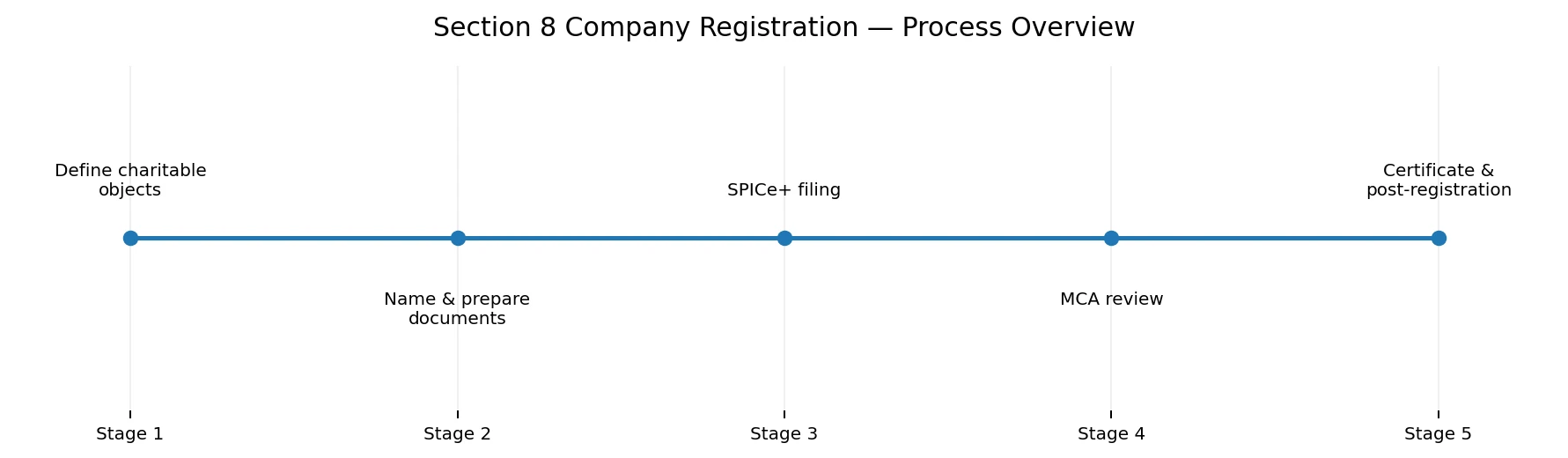
This diagram shows the sequence of major stages, not a guaranteed timeline. MCA processing time varies with application completeness and review.
Quick Reference Table
| Area | Key requirement / fact | Action point |
|---|---|---|
| Purpose | Promote charitable / public-benefit objects; profits applied to objects | Define objectives clearly |
| Legal basis | Section 8, Companies Act, 2013 | Review current law and rules |
| Members / directors | Generally at least 2 members and 2 directors for a private Section 8 company; structure-specific rules apply | Confirm intended company type |
| Name | Often includes words such as Foundation, Association, Forum or Council | Check MCA name availability |
| Core filing | SPICe+ and applicable linked forms / attachments | Use current MCA workflow |
| Documents | Identity/address proofs, MOA/AOA, office proof, NOC and declarations as applicable | Prepare consistent, valid documents |
| Income use | Income/profits must be used to promote objects; dividends to members are prohibited | Set financial controls |
| Ongoing duties | Accounting, statutory audit and applicable annual MCA / tax filings | Create compliance calendar |
| Tax exemption | Not automatic merely because it is a Section 8 company | Check separate tax registrations / approvals |
Introduction
If you are planning to establish an NGO, charitable organisation or public-benefit initiative, choosing the right legal structure is an important first step. In India, a Section 8 Company is a not-for-profit company formed to promote specified objectives such as education, social welfare, science, art, research, sports, charity, environmental protection or similar purposes.
Section 8 company registration can provide a formal corporate structure, defined governance responsibilities and a separate legal identity. However, it also brings statutory compliance requirements, and incorporation alone does not automatically provide income-tax exemption or donor tax benefits.
This guide explains Section 8 company registration in India, including eligibility, documents, the registration process, benefits, costs, timelines and post-registration compliance.
What Is a Section 8 Company?
A Section 8 Company is incorporated under Section 8 of the Companies Act, 2013 for promoting eligible charitable or public-benefit objects. Its income and profits must be applied towards its stated objectives, and it cannot distribute dividends to its members.
Unlike an informal initiative, a Section 8 Company has a separate legal identity and operates through its constitutional documents, directors and members. It may receive donations, grants, membership fees or other lawful income, provided these are managed consistently with its objects and applicable rules.
Quick answer: A Section 8 Company is an Indian not-for-profit company created to promote charitable or public-benefit objectives, with profits applied to those objectives rather than distributed as dividends.
Who Can Register a Section 8 Company in India?
Individuals and eligible entities may participate in forming a Section 8 Company, subject to the Companies Act and applicable incorporation rules. The proposed organisation must have lawful objects that fall within the purposes recognised under Section 8.
For a private company structure, at least two members and two directors are generally required. Public company structures have different minimum requirements. A director must meet the applicable legal eligibility conditions and provide consent and identification details as required.
Common purposes include: • Education, skill development and research. • Healthcare, public health and social welfare. • Environmental protection and sustainability. • Arts, culture, science, sports and community development. • Charitable activities and other eligible public-benefit objectives.
The proposed objects should be clearly drafted and must not be designed to distribute profits to members. Confirm the appropriate company type and eligibility before filing.
Benefits of Section 8 Company Registration
- Separate legal identity: The company can hold property, enter contracts and conduct activities in its own name, subject to law.
- Structured governance: The Companies Act framework provides defined responsibilities for directors, members and statutory records.
- Potential credibility: Formal incorporation can help the organisation present its structure to donors, institutions, partners and grant-making bodies. Funding is never guaranteed by incorporation alone.
- Continuity: The organisation can continue its activities despite changes in individual members or directors, subject to its governing documents and law.
- No dividend distribution: Resources are directed towards the company's stated objects rather than distributed as profits to members.
- Fundraising framework: A Section 8 Company may receive lawful donations, grants and other permitted income. Specific funding programmes may impose additional eligibility requirements.
Important: Section 8 status does not automatically grant exemption under the Income-tax Act or make donations eligible for donor deductions. Separate registrations or approvals may be needed, depending on the intended tax treatment and activities.
Documents Required for Section 8 Company Registration
Exact requirements depend on the proposed structure and current MCA filing workflow. Commonly requested documents include:
For subscribers and directors: • PAN or other applicable identity proof. • Residential address proof, such as an accepted bank statement or utility bill. • Photograph, email address and mobile number, where required. • Director consent and applicable declarations. • Digital Signature Certificates (DSCs) for relevant signatories.
For the registered office: • Recent utility bill accepted under current rules. • Ownership proof or rent/lease agreement, as applicable. • No-Objection Certificate (NOC) from the property owner, where required.
For the organisation: • Proposed name and main objects. • Memorandum of Association (MOA) and Articles of Association (AOA). • Applicable declarations, professional certifications and incorporation forms. • A realistic estimate of future income and expenditure may be required under the applicable rules.
Keep names, addresses and supporting records consistent across the application. The MCA's current forms and instructions should be checked before submission.
How to Register a Section 8 Company: Step-by-Step Process
Step 1: Define the organisation's objects. Identify the public-benefit purpose and draft specific, lawful objectives that fit Section 8.
Step 2: Choose a suitable name. Select a name that reflects the organisation's purpose and meets MCA naming rules. Names commonly use terms such as Foundation, Association, Forum, Council or similar expressions, subject to availability and applicable rules.
Step 3: Arrange Digital Signature Certificates. The relevant subscribers and directors need valid digital signatures for applicable electronic filings.
Step 4: Prepare MOA, AOA and supporting records. The constitutional documents should align with the proposed charitable objects and Section 8 restrictions.
Step 5: File through the MCA incorporation process. New Section 8 companies generally use SPICe+ and applicable linked forms and attachments. The current MCA workflow should be followed; older guidance referring to a separate INC-12 licence application for a new company may be outdated.
Step 6: Respond to MCA queries. Review any resubmission request carefully and provide accurate clarifications or corrected documents.
Step 7: Receive incorporation documents. Once approved, the Registrar issues the Certificate of Incorporation and the applicable Section 8 licence documentation through the prescribed process.
The exact filing sequence and attachments can change, so use the latest MCA portal instructions or seek professional support.
Section 8 Company Registration Fees and Timeline
The cost of Section 8 company registration depends on factors such as state stamp duty, digital signature requirements, professional fees and the services included in the engagement. Government charges and professional fees should be listed separately in a quotation.
Processing time depends on name availability, document accuracy, application volume and MCA review. Any timeline offered by a service provider should be treated as an estimate, not a guarantee. Missing documents or requests for clarification can extend the process.
Before engaging a provider, ask what is included: name application, drafting of MOA/AOA, incorporation filings, DSCs, government charges and post-incorporation guidance.
Compliance After Registration
Incorporation is the beginning of the organisation's legal responsibilities. A Section 8 Company should plan for:
• Accounting records: Maintain complete books, supporting invoices, donation records and financial documentation. • Statutory audit: Comply with applicable audit requirements under company law. • Annual MCA filings: File financial statements, annual returns and other applicable forms within the prescribed deadlines. • Board and member records: Maintain minutes, resolutions, registers and statutory records as required. • Tax compliance: Assess income-tax return, TDS, GST and other obligations based on activities and applicable law. • Fund and grant conditions: Follow restrictions and reporting requirements attached to donations, grants or funding agreements. • Changes in company details: File applicable forms when directors, registered office or other reportable particulars change.
A compliance calendar and reliable bookkeeping process can help prevent missed deadlines. Requirements can vary with the organisation's activity and circumstances, so obtain professional advice where necessary.
Section 8 Company vs Trust vs Society
The best legal structure depends on the organisation's purpose, governance preference, fundraising plans and state-specific requirements.
A Section 8 Company is governed by the Companies Act, 2013 and has company-law reporting obligations. A trust is generally created through a trust deed and is governed by applicable trust law. A society is registered under the relevant societies legislation and has its own governance and filing framework.
Do not select a structure based only on registration cost. Compare management flexibility, reporting duties, eligibility for grants, donor requirements and long-term plans before deciding.
Conclusion: Build Your Non-Profit on a Strong Legal Foundation
Section 8 Company registration can provide a formal legal structure for organisations working in education, healthcare, environmental protection, research, social welfare and other public-benefit areas. The organisation must ensure that its objectives, use of income and governance remain consistent with Section 8 requirements.
Before applying, prepare a clear objects clause, confirm the appropriate structure, organise documents and plan for ongoing accounting, audit, tax and annual filings.
Need assistance exploring business or non-profit registration? Taxplan Advisor can help you understand registration services and the documents relevant to your requirements.
Learn more: https://www.taxplanadvisor.in/services/registrations
Disclaimer: This article is for general informational purposes and is not legal or tax advice. Confirm the latest MCA requirements and seek qualified professional advice before filing.
Taxplan Advisor
Need Help With This?
Taxplan Advisor can help you register a Section 8 company.
Official sources and references
Frequently Asked Questions
Is a Section 8 Company an NGO?
It is a commonly used legal structure for NGOs and not-for-profit initiatives, provided its objects and operations meet the law.
Can a Section 8 Company earn income?
Yes. It may earn lawful income, but its profits must be applied to its objectives and cannot be distributed as dividends to members.
Does Section 8 registration automatically provide 12A or 80G benefits?
No. Income-tax exemption and donor deduction eligibility involve separate provisions and approvals, where applicable.
Can a Section 8 Company receive donations?
It may receive lawful donations and grants subject to applicable law, donor conditions and any relevant registration requirements.
Is audit compulsory?
Section 8 Companies are subject to applicable statutory audit and company-law compliance requirements. Confirm the precise obligations with a qualified professional.
How much does Section 8 registration cost?
The total varies with government charges, state stamp duty, DSCs and professional services. Request an itemised quotation.
Where is a Section 8 Company registered?
Incorporation is processed through the Ministry of Corporate Affairs (MCA) and the relevant Registrar of Companies under the applicable procedure.