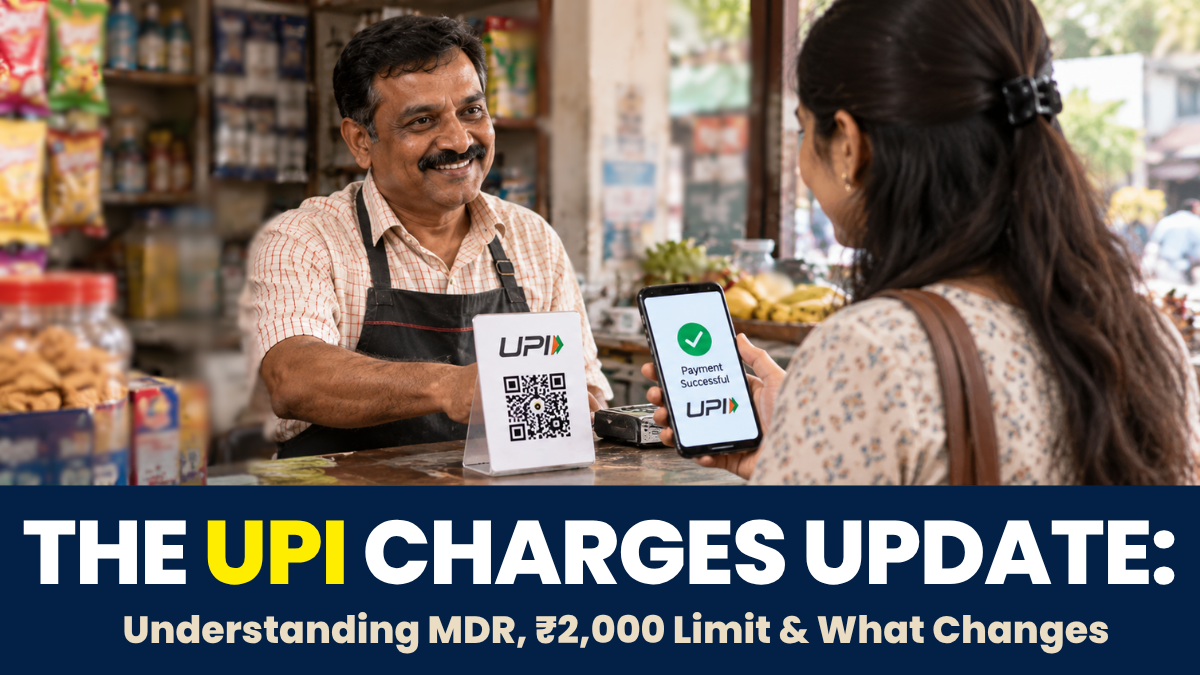
Executive Summary
UPI is not becoming generally chargeable for consumers. Person-to-person (P2P) UPI payments remain free, merchant payments up to ₹2,000 remain free of Merchant Discount Rate (MDR), and eligible small merchants continue under zero-MDR provisions. A limited category of higher-value merchant transactions can attract MDR. MDR is an ecosystem charge rather than a tax collected by the Government or NPCI.
What Exactly Has Changed?
The updated framework creates an enabling mechanism for charges on specified electronic payment transactions. The practical impact is concentrated on selected person-to-merchant (P2M) transactions above ₹2,000. According to the Ministry of Finance, about 96% of merchant UPI transactions remain unaffected.
UPI Charges at a Glance
| Transaction / Category | Applicable treatment |
|---|---|
| P2P UPI transactions | 0% / Free |
| Merchant payments up to ₹2,000 | 0% MDR |
| Eligible small merchants under zero-MDR framework | 0% MDR |
| Certain merchant transactions above ₹2,000 | 0.4% MDR |
| Qualifying transaction of ₹75,000 or more | MDR capped at ₹300 |
| Specified essential sectors above ₹2,000 | Flat ₹5 MDR |
| Specified capital-market transactions | 0.02%, capped at ₹300 |
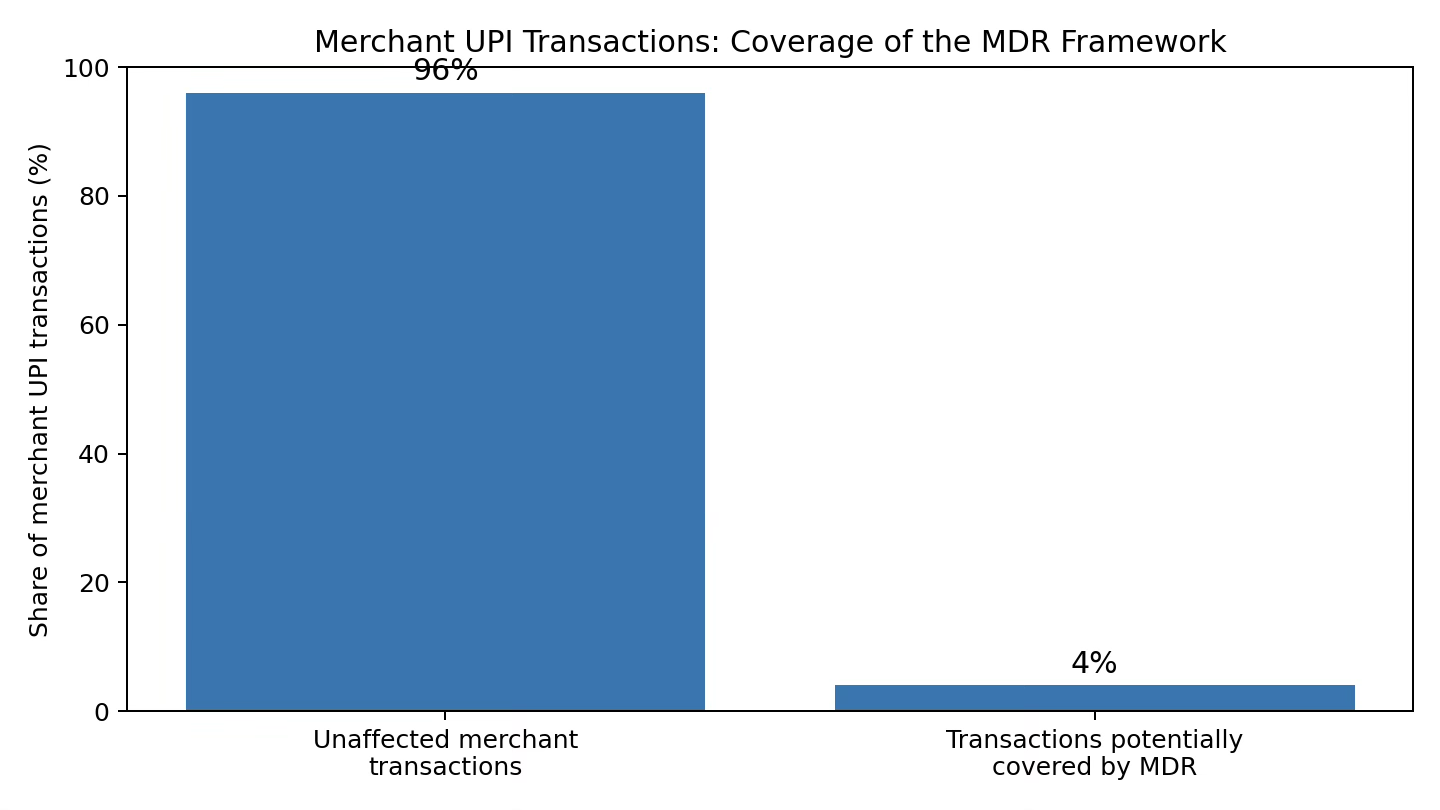
Figure 1: Share of merchant UPI transactions described by the Ministry of Finance as unaffected versus potentially covered by the MDR framework.
How Does MDR Work?
MDR stands for Merchant Discount Rate. It is a payment-processing charge associated with certain merchant transactions. It is not the same thing as a consumer UPI fee or a Government tax.
Illustrative example: if a qualifying merchant transaction is ₹10,000 and the applicable MDR is 0.4%, the MDR calculation is ₹10,000 × 0.4% = ₹40. This does not mean the customer should automatically be asked to pay an extra ₹40. MDR is handled within the payment ecosystem under the applicable framework.
Payment Flow: From Customer to Merchant
| Stage | What happens |
|---|---|
| 1. Customer | Scans QR / selects UPI and enters the amount. |
| 2. Authentication | Customer authorises the transaction using the UPI authentication method. |
| 3. UPI processing | The UPI infrastructure routes and processes the payment. |
| 4. Banking participants | Relevant banks/payment service providers participate in processing and settlement. |
| 5. Merchant side | Funds are credited to the merchant according to the settlement process. |
| 6. MDR, where applicable | Applicable ecosystem charges are processed under the relevant framework. |
Who Remains Unaffected?
-
P2P payments between individuals.
-
Merchant payments up to ₹2,000.
-
Eligible small merchants covered by the zero-MDR framework.
-
Consumers are not subject to a universal monthly UPI fee.
-
UPI does not become a general-purpose paid service because MDR exists for selected transactions.
Potential Impact on Consumers
For ordinary consumers, the direct effect is limited because the main everyday use cases—sending money to another person and making merchant payments up to ₹2,000—remain free of MDR. Consumers should nevertheless check the payment screen and merchant receipt for any separately disclosed fee and distinguish an MDR issue from unrelated bank or service charges.
Potential Impact on Small Businesses
Small businesses are a major part of the UPI ecosystem. The zero-MDR treatment for eligible small merchants is intended to limit payment costs for qualifying low-volume businesses, including relevant neighbourhood shops and street vendors.
Potential Impact on Larger Merchants
Larger merchants processing qualifying higher-value payments may have MDR as part of their payment-processing economics. Businesses may therefore need to include payment acceptance costs when evaluating their payment mix, margins and settlement arrangements.
Potential Impact on Banks and Fintech Companies
A structured revenue mechanism for selected transactions can support the economics of payment infrastructure. Potential areas of investment include cybersecurity, fraud prevention, system reliability, customer support and technology upgrades. Actual commercial outcomes will depend on implementation, competition and future regulatory changes.
Market-Level Effects
| Area | Possible effect | What to monitor |
|---|---|---|
| Consumers | Most routine UPI use remains free | Any separately disclosed merchant/service fee |
| Small merchants | Eligible merchants retain zero-MDR treatment | Eligibility and transaction limits |
| Larger merchants | Potential MDR cost on qualifying transactions | Payment costs and settlement economics |
| Banks / PSPs | Potential additional ecosystem revenue on covered transactions | Infrastructure and compliance investment |
| Fintech apps | Revenue and cost structures may evolve | Competition, incentives and user experience |
| Digital payments market | Could support sustainability while preserving broad free usage | Transaction volumes, adoption and future policy |
Illustrative MDR Calculation Table
| Transaction value | Illustrative rate | Illustrative MDR | Important note |
|---|---|---|---|
| ₹1,500 | 0% | ₹0 | Within the ₹2,000 zero-MDR threshold |
| ₹2,000 | 0% | ₹0 | Within the ₹2,000 zero-MDR threshold |
| ₹10,000 | 0.4% | ₹40 | Only where the transaction qualifies for 0.4% MDR |
| ₹50,000 | 0.4% | ₹200 | Only where the transaction qualifies for 0.4% MDR |
| ₹75,000 | 0.4% | ₹300 | Illustrates the stated ₹300 cap |
| ₹1,00,000 | 0.4% / cap | ₹300 | Illustrates the stated cap, subject to eligibility |
Note
The calculation examples are mathematical illustrations of the stated rates/caps; they are not a statement that every transaction at that value attracts MDR.
Benefits and Considerations for the Market
Potential benefits:
-
Creates a defined revenue mechanism for selected higher-value merchant payments.
-
Can contribute to the financial sustainability of payment infrastructure.
-
Maintains zero-MDR treatment for P2P payments and many everyday merchant transactions.
-
Protects eligible small merchants from MDR under the specified framework.
-
Can support continued investment in security, reliability and payment technology.
Important considerations:
-
Merchants need to understand which transactions fall within the applicable MDR category.
-
Payment providers must implement the framework consistently and transparently.
-
Users should distinguish MDR from taxes or unrelated bank/service fees.
-
Future rules, thresholds or commercial arrangements can change, so official updates remain important.
Key Takeaways
| Question | Answer |
|---|---|
| Is all UPI now chargeable? | No. |
| Are P2P UPI payments charged MDR? | No. |
| Are merchant payments up to ₹2,000 subject to MDR? | No. |
| Can certain merchant payments above ₹2,000 attract MDR? | Yes. |
| Is MDR a Government tax? | No. |
| Does MDR automatically mean an extra charge for the customer? | No; it is an ecosystem charge and merchants should not separately pass MDR to customers as an additional UPI fee under the stated framework. |
Conclusion
UPI remains a core part of India's digital-payment infrastructure. The updated MDR framework does not turn UPI into a universally paid service. Instead, it establishes a mechanism for MDR on specified higher-value merchant transactions while retaining zero-MDR treatment for P2P payments, merchant payments up to ₹2,000 and eligible small merchants. The longer-term market effect will depend on how banks, payment providers, merchants and regulators implement the framework and how the economics of digital payments evolve.
Taxplan Advisor
Need Help With This?
Taxplan can help your business understand payment and settlement costs, including how MDR may affect your UPI transactions.
Official Sources & References
-
Ministry of Finance / Press Information Bureau: clarification on UPI MDR framework and transaction coverage, September 2026.
-
NPCI: UPI Product Statistics, August 2026.
-
Ministry of Finance / PIB: clarification on GST-related claims concerning UPI transactions, 2025.
Editorial note
For publication, verify the latest official circulars/notifications from the Ministry of Finance, RBI and NPCI before posting.